

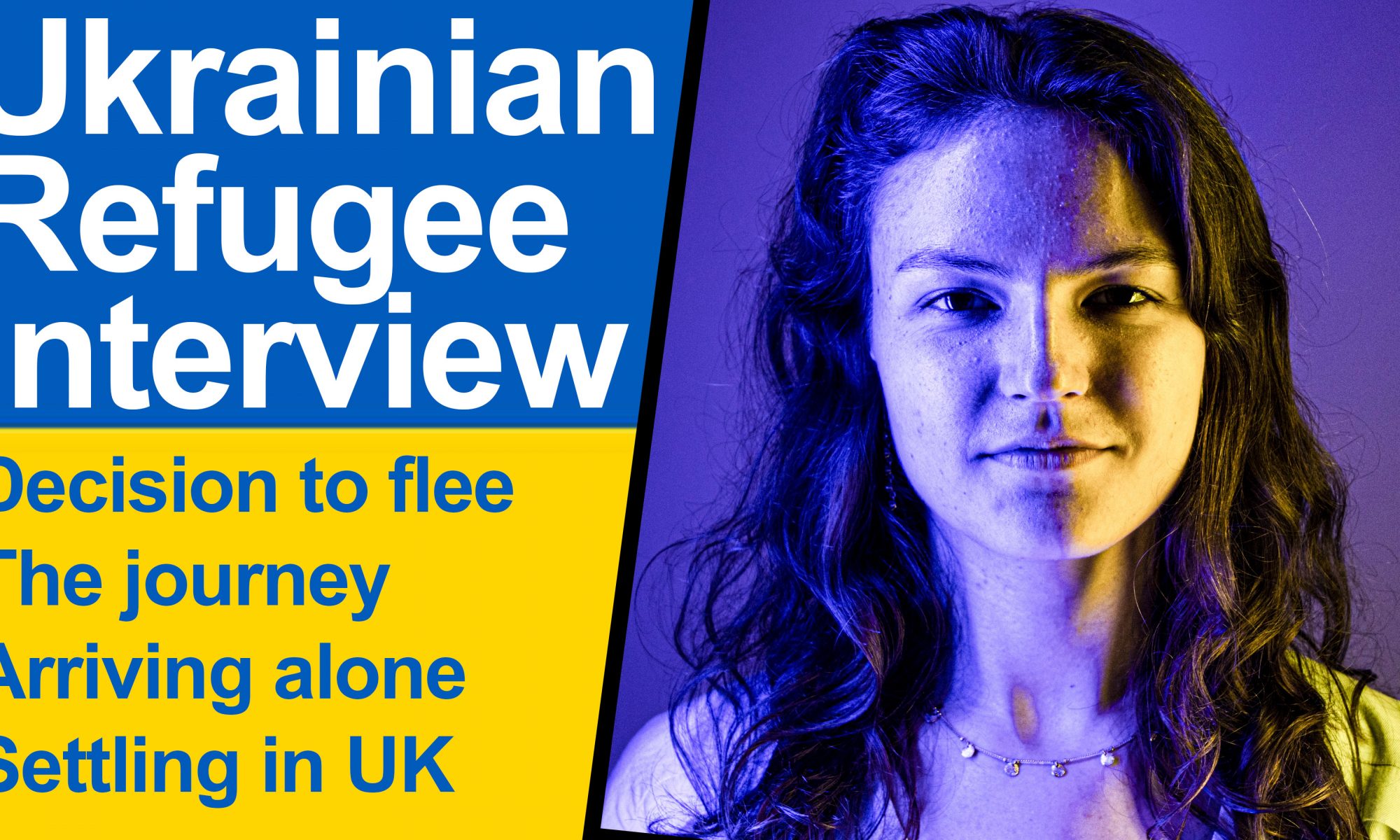
Polina is a Ukrainian refugee from Sloviansk in the East of the country. This is her story about her life in Ukraine beofre the war. Living under bombing. Her decision to flee the country and settling into the UK after arriving alone in the country.
I’d like to thank Polina for her time. A transcript of the interview is below.
- [James] Do you think any of your friends and family will see this video? Are you gonna send this to them? If they’re gonna watch this video, what would you say to them, what message would you give them? What is your name and where are you from?
- My name is Polina, I’m from Ukraine. My home city is Sloviansk, my student city is Kharkiv.
- [James] Where, so for people who don’t know, where is that in Ukraine, what part of Ukraine is that?
- It’s East part of Ukraine, it’s very close to Russian border, even like Kharkiv and my home city. My hometown is small, I think it’s like 100,000 people. And there are like 12, 13 schools. We also have one university. But when you say about like opportunities for teenagers, for the students, it’s not so big. So I moved to have a university degree in other city.
- [James] So how long did you live in your, like the city you grew up in, like as a child?
- 16 Years.
- [James] So you left when you were 16?
- Yes, yes.
- [James] So after that, so when you were 16, I mean, in England, were you going to do A Levels after that? What did you do? Did you go, what would you call, the next bit of education after that, when you’re 16 years old?
- We have like at school we have 11 years of degree and now it’s 12 years, and after this, you pass your exam and go to university, you do Bachelor Degree.
- [James] Okay. So where did you go to university?
- I went to Kharkiv, my university name is Karazin University. It has like 23 departments and it’s a huge university, and it’s also a huge student life there. And in that city, we also have like 33, 34 universities.
- [James] So going back to your hometown, what sort of thing would you do when you were a child, or when you were younger to kind of relax, where would you go? Even if it was naughty or whatever, if you got up to mischief or anything?
- Like I was really active child. I had my dance classes, English classes. I also had like sports classes and I also need to study and do my homework, but we also had, like my mom and dad, they had weekends, so I could go to the lakes, nature, to the forests. So it’s like, it was also be surrounded by very beautiful territory. So it was really nice to went there.
- [James] So I think you said to us, a couple of weeks ago that it was your birthday.
- Yes.
- [James] So what would you do in Ukraine, when it was your birthday? How would you celebrate that with your family?
- We often goes to, it’s because it’s the summer, we went to the lake, we had like strawberries, champagne, we can go to swim, we could like be on the field in the forest, and it’s all about like communication with your family, with your friends. We also play board games and volleyball, yes.
- [James] So larger silliness?
- Yeah.
- [James] Lots of champagne.
- More strawberries.
- [James] I kind of wanna know, what is like, a normal weekend look like when you are in Ukraine? Like when you are relaxing currently, say like a year ago, what would like a normal weekend look like? What would you get up to?
- It looks like in Britain, we could have our barbecue, but it’s named like, we have a shashlik and we could go to the, to our friends, our family, and yeah, it’s just about communication. We could also went to other cities because Ukraine is a big country and you can visit, like, you can go to mountains, you can go to the sea, you can go to the river and you could also visit like big cities, like Kyiv or Lviv.
- [James] Do you go clubbing or anything like that?
- Yes, but it’s all about students. Yeah, we have like in Kharkiv, we have a lot of clubs and yeah, they are very popular because we also had students, abroad students and they really like that. And it’s, that’s more night lifestyle, it’s not about family.
- [James] What’s like the student life like, is it similar, I mean, we are talking in Cambridge now. Would you say it’s similar to Cambridge?
- No, no. It’s my part of Ukraine, so it’s not similar. I lived in dormitory, like for five years. So dormitory it’s like, a huge part of student life, because you also live not, you live with Ukrainian students, but also with students from other countries, like in Cambridge, you also would be involved in different activities. It would be sports activities, it would be like festival activities, and because students need this, you have this.
- [James] And what about education as well for you? How do you find are the university courses good, I mean, what’s the education like?
- University. I really liked Ukrainian universities because in compare with English universities, we could have free education. So I was studying for free and I also had my scholarship in Ukraine. So it’s like a big plus, because I know that in Britain, a lot of students need to have a student loan to study.
- [James] It’s expensive here.
- Yes, but it’s also, if we compare with Ukrainian salaries, it’s also very expensive to study in Ukraine. So I don’t think that I would afford to study my Master’s Degree, if I wouldn’t have like free education.
- [James] So where’s the money come from for that? Is it subsidised by the government, from taxes?
- Yes, it’s governmental.
- [James] Wow, that’s pretty cool. I like it, that’s good. What were you studying as well?
- I studied psychology in my Bachelor Degree and also psychology in my Master’s Degree. It’s like general psychology. We don’t have like educational or clinic psychology. We studied all the courses, and yeah, you can choose where to go after the university.
- [James] So what did you want to do as a career when you were going into uni? What were you planning to do?
- I was planning, like I have no idea what is psychology. So it was a little bit interesting for me, what I will have in the end. But like now, as I see it was like a great step because I had a lot of knowledge, not only about people, but also the system, how all people are connected, how their brain works, and it’s also about psychology with children, and yeah, like, I understand that in Britain, it’s a little bit other education because you have a lot of research psychology and we don’t have this field in like very, it’s not developed in Ukraine because you need to have money for research, and all my professors and lecturers, they do their research by their own. So if they want to do this, they need to pay for this.
- [James] They need to raise the money themselves to do it.
- Yes, yes.
- [James] So you were saying about child psychology, were you thinking about working with children once you qualified?
- Yeah, it’s very interesting. I understand that when you are with children, you can influence on them. You can help them more than when it’s an adult. When my mom also, she like a teacher in the kindergarten, so it’s also like connected with her work, and I understand that you could have, you also could know a lot from children. Like when you are adult, you see like the general, and when you are children, you could see a lot of details, something interesting, just like, I don’t know, in the ground.
- [James] Do you think that children, kind of live simpler lives, don’t they?
- Yes.
- [James] And they’re purer.
- Yeah, they don’t need a lot. Like, if they will live only in their village, they will find what to do. But when you are an adult, you just, oh, you don’t have a work in the village, and so on. Like, you are only connected to like, to the general marks.
- [James] Yeah, you mentioned your mom. Do you wanna talk a bit about your family?
- Yeah, okay.
- [James] So, well, tell us about your family then.
- I really like my mom, my dad, yes, I think I miss them, but I understand that my original thinking, understand that now I’m in more safer place where than I was, so I need to be there now.
- [James] So you said your mom’s a kindergarten teacher?
- Yeah.
- [James] How old is she, if you don’t mind me asking?
- 50.
- [James] 50?
- Yeah.
- [James] Okay, and your father?
- He doesn’t work now, he’s 56.
- [James] 56, okay. Do you have any brothers or sisters?
- No.
- [James] So you’re an only child?
- Yes, yes.
- [James] Okay, and they’re obviously still in Ukraine at the moment?
- Yeah.
- [James] Okay. Do you have a boyfriend?
- Yes.
- [James] And he’s still in Ukraine as well?
- Yes.
- [James] Okay, how did you meet, how did you meet your boyfriend?
- It was in Kharkiv and we met like earlier, we met in our home city, he’s from my home city, but then we start to study in Kharkiv together and yeah.
- [James] So what were your mom and dad doing? I mean, what were they, you say your mom was kindergarten teacher, your dad’s not working, what were they doing like day to day?
- Work.
- [James] Just work, just normal work.
- My mom had her work, like from 7:00 in the morning, till 6:00 in the evening. And after six, she also has a garden, she like garden, she like flowers, trees. And after six, she is the whole evening in garden and then goes to sleep, and then again, work day.
- [James] What does she do in the winter then? Cause it must be so cold, like how can you garden in a Ukrainian winter?
- In the winter she has home plants.
- [James] But like light the fire, have a glass of wine.
- No, no, no, no, no. From Kharkiv to my home city, it’s like four hours by train. So when I went to the weekend there, we always like, we go someone to the guests. So we have guests in our home and like go somewhere also in the winter. I like winter forest when it’s all snow and yeah, you are even cold, but you have a cup of tea with you, and yeah, it’s like very beautiful. And yeah, I can’t say that winter is very long.
- [James] So what do people your age, want from life in Ukraine?
- We also, like, not a lot of people start to think about family in my age. It’s like maybe 40% of like, they created their families and, they think about their career, but a lot of people stay in their home cities and raise their children there. And also some of the people with like, who really involved in activities in Ukraine, like volunteering, like trying to change something in Ukraine, they, I think about this, only for their age, maybe in 25, in 30, they will start also think about the family, but right now, when you don’t have a child, when you don’t have like a wife or you could, you have more energy to put it in the life changes and country changes.
- [James] You say country changes, what do you think needed changing? Was there anything in Ukraine you thought needed changing?
- It depends on the city where you are, like in small cities, it’s more about corruption.
- [James] Yeah.
- Yeah, it’s still, yeah, it changed, but it’s still there. And also when it’s a big cities, you need to solve problems like, you want to have your park in the city, not huge buildings instead of the park. And a lot of people try to stop, they also have the strikes and they try to stop the builders. And sometimes they did this, but like, there are a lot of things that you want to change or.
- [James] Yeah, I feel the same about my country. I think maybe, I think you just want things similar to someone in England, don’t you? I guess. If you’re young and you don’t have kids, enjoy your life and do something for the community, and if you’re older and you’ve got kids, then you’re tired and that’s the end of your life.
- No, no, no, no, no, no. Sometimes if you will, with a child, you also stay active and yeah, maybe it doesn’t depends on your age, but it depends on your, I don’t know, inner power.
- [James] Well, you said about being older and active and you said your mom was always in the garden. What would your dad do for relaxing?
- He’s also in the garden. They live in different places and he has like two hectares.
- [James] Yes, yeah.
- Of, yeah, and he, he has a lot of work to do.
- [James] So, it’s mad. You said to us before this interview, you’re worried about your English, but you know really unusual words like hectares, that’s the same.
- Because it’s an Ukrainian gift.
- [James] Okay, are you cheating then? Polina, can you tell me about the war and your life over the last 10 years, leading up to the last six months. So did you, the war’s been going on in Ukraine between Ukraine and Russia for nearly 10 years now, hasn’t it?
- Yes, and my city, it’s one of the cities that felt it from 2014. And we, like even from 2014, we had our windows crashed and yeah, and I couldn’t imagine that I will, like, after three months is all what it happens in our cities. They went to the Donetsk mainly, like Horlivka and other cities, and Lugansk region also. But people start to forget, if it isn’t happens in your city, they start to forget that it’s still war somewhere. And it’s even, you can feel this now that people now in Kyiv, they already have like the parties and they, it looks like that like two, three months, it’s like a scary dream. And it’s like, that’s all, it’s finished and everything is okay, but it’s not okay. I understand that you want to have your real life, you want to feel the life and to do something, but you don’t need to forget that some people today, they don’t have food, they don’t have water. And even like in my city now, it’s under Ukraine, but it’s very close to the occupied territory. And my neighbours who are staying here, they don’t have light, water, gas, and it’s really hard for them to cook something or just, I don’t know, to have a tea. And when you start to think about this, you start to like, to be more grateful about like very easy scenes, like yeah, you have a bus, you could have a bus and some people don’t, and yeah, it’s really changed.
- [James] How far was your hometown from the fighting, in the last 10 years?
- It’s maybe-
- [James] You said you had windows smashed in and things.
- Yeah, our city, it was the first city which felt this. And it was, yeah, I remember that I was how many years? I was 14, 13. And I remember how afraid I was, and also, I had heard a lot of stories. Like my mom she’s works a teacher and she had worked there for 30 years. And she also heard a lot of stories from her parents who gave her the children, how they, what situations they had in that moment. Like, I know that two of her girls, they were afraid of the gun and they can’t speak now for 10 years.
- [James] They’re mute, they don’t talk?
- Yes.
- [James] Because of-
- Because somebody from Russia, when they were in the city, he had the gun to their faces and they were afraid. So, they yeah.
- [James] So have you, before the war changed, cause let’s kind of look at it from two perspectives. So before the last six months, let’s talk about that for now, if we can. And then we’ll talk about the last six months in a few minutes. So before in the earlier part of the war, did you have any experience of the conflict yourself?
- Yeah, like what type of conflict do you mean?
- [James] So Russia-Ukraine conflict before the last six months. So when you were living at home, when you were younger.
- It was 2014, I finished my ninth year of the school and we wanted to go somewhere from our city, but we also can’t do this because we had four grandparents in the city and they don’t want to move somewhere because they old and they say no, like they can’t move even for their neighbour. And we collect all our grandparents together in one house. We like bought some like food, I don’t know. We haven’t known for how many days, for how many months since we left. We left the city and we went to my mom’s sister and I stayed here for six months, and my mom went back in one month to her parents. And I remember that then when we wanted to leave our home city, we called the bus and he said, “Yeah, we will go tomorrow.” But then something happened on the road or with the train line and buses stopped to go. And we tried to go out of the city like for six days. And it was like, when you want, to went and you are afraid also that something go happened in your house, in the road, and it was really scary, like, I start to forgot this, but like in the last six months, I just feel this again, and I understand that brain has a lot of like, he memorise a lot of things yeah.
- [James] From your psychology.
- Yeah, yeah, yeah.
- [James] Yeah. So you tried to leave the city when you were, in 2014?
- Yeah.
- [James] And then what happened then? Did everything die down or did the war settle?
- It happened in the first day of May. It all started to happen and we moved the city in the middle of June and in July, I don’t know who say the soldiers, but they moved from our city, Sloviansk, and from Kramatorsk, they went to the Donetsk. So it’s just moved.
- [James] The war moved.
- Yes. So it doesn’t say that it’s stopped, no.
- [James] It’s focus moved elsewhere, to another geographic area.
- Yes, maybe, I don’t know, for a while, maybe it’s like more money reasons because in Donetsk it’s more factories and so on, so it’s more interesting for them, but yeah, it’s moved, but a lot of people, since there, they went also in other cities and they stayed in that city, They have never returned to our city.
- [James] So, when you left, did you eventually leave in 2014? You said you tried six days to leave.
- Yeah, we left, but yeah, we wanted to go back and we went back and yeah, I was continue my school education in my home city.
- [James] Did you have any friends from school who left and didn’t come back? Have they stayed away or?
- It’s hard to say because I finished my ninth year and then I went to another school. So yeah, I didn’t-
- [James] It’s hard to say.
- Yeah, yeah, yeah, yeah.
- [James] I understand. So let’s talk about the last six months. So when did things start to worry you, when were you, was it kind of sudden, or did you, because for us in the UK, there was talk of something about to happen two weeks before the war started. And personally, I didn’t think that they’d be stupid enough to do anything. Did you feel that there was, was there a much longer run up to the current change in conflict?
- It was a huge tension. It starts in the first days of January. And like all people start to talk about something and start to think, some of them also had their bags already, like if they want to move, they could have them and-
- [James] Oh, bags packed ready?
- Yes, yes.
- [James] Did you have bags packed ready?
- No, I couldn’t imagine that this could happen again. Like I was like, no, no, no, it couldn’t. And when like 21st of February, my dad called me in the 4:00 of the morning, and he says that something started and I packed my documents, packed some of the things, but we hadn’t had a car and I couldn’t, and also it was like, you know, some action in all different cities of Ukraine. So you, when you see a map and you don’t know where to move, because it all seems unsafe. And we, I remember that I had my bath, fill my bath with water, in case it wouldn’t be stopped water and we have a water and it’s a stupid reaction, but yeah-
- [James] That seems like a really good idea to me. It’s a good idea.
- Yeah, but a lot of people I remember, and we were like 5:00, 6:00, in the morning, a lot of people just, who have cars, just you see the car moves. But again, like I haven’t known where I could go because I was in Kharkiv, I understand that Sloviansk, it’s very vulnerable city, because Russia wants to have it, and I can’t go home.
- [James] Was your mom and dad back at home?
- They were at home.
- [James] In Sloviansk?
- Sloviansk.
- [James] Sloviansk.
- Yes, and I stayed in Kharkiv for three weeks. And it was, I remember that we had two rooms and kitchen and like some kind of the room where the shoes are, but it don’t have windows. So in one week we moved our bed to that room because it’s also, you can’t hear the noise a lot in that room.
- [James] What noises?
- We heard a lot of planes, and it was Russia planes. And we were in the centre of Kharkiv. And I remember the day, maybe you saw the video where the bomb is crashed to the centre of Kharkiv. I remember that when, like I got up in that moment and yeah, I couldn’t sleep because you start to hear the, you also have noises because of the alarm, like you-
- [James] Air raid siren?
- Yes. And also they duplicate them with the bells of the churches. So like, when you want to go to sleep, you start to, again noises and also the like rockets, you could hear them, but as I said, you also afraid to move, because when you see like how people move and they could die and you just stay in the, you try to stay in the safe place, and yeah, I couldn’t imagine how it was damaging for my health, but I understand that I’m not experienced. Like, it was like the ordinary, since you start to think that it’s okay, like you hear this noise, and a lot of people start to think that it’s okay. But when we move to the Central Ukraine, and when you had a silence night, you understand that all that, it was not okay. That-
- [James] The difference.
- Yes, yes. That it was, that you can go to the shop and you can hear the rockets, like very close to you and you are still going to the shops because it happens always.
- [James] Sorry. Let’s just take a very quick break. So I just wanna make sure that the sound is working on my end quite well. You okay?
- Yeah, yeah. It’s very hard to say this in English.
- [James] It’s fine, no don’t worry. You’re doing better than I would, if it was in Ukrainian. The city was quite badly bombed, wasn’t it? By the Russians at the start, in the latest phase of the war.
- Yeah.
- [James] Were you there during that bombing?
- Yes, yes. I was in the bad area, but not so bad. The worst area it was named Saltivka. It’s the region of Kharkiv, where there are a lot of apartments for ordinary people, like the houses with like 20 floors, 15 floors, nine floors. And I know a lot of people, who don’t have their apartments now, and who I also, one of my friends, she stayed all this time because she was from that region of Kharkiv, from that area, and she stayed in the underground for two months. Yes, and it’s a huge-
- [James] Did you ever go to an underground shelter?
- No, so I, I could say that I already felt this in 2014, like the first impression that this would be happen something, and I’m afraid, but I already saw this and I already felt this. And I know that if you will stay in your house, but in the safer place, and you also, like, we know the rule of two walls, that if the one wall is crashed, you need to be after the second wall, and it would be safer place there. And also without windows, because you could have a lot of-
- [James] Glass.
- Yeah, so it’s very unsafe and, we just chose the safer place in the apartment.
- [James] You speak about where you should hide, and, you know, if the wall falls down, you should be next to the other wall and you should not be near windows, things like that. Things that, you know, most people in, most young people in every other country wouldn’t know about. Do you ever sort of find yourself thinking, wow, I can’t believe I, you know, you said that all there as if it was second nature almost, you know, it’s almost part of you.
- Yeah, it’s scared me because I understand that when children play in, like in the war, like they play in their garden, in the war or block posts. And I understand that it’s need to be scary that because it’s not natural that people, or that when a child, like six years old and he thinks about that, putting need to be killed or just die, and it’s like six year old.
- [James] Yeah.
- I couldn’t imagine what would be with this children, like in 10 years, in 15 years, because they grow up in this atmosphere and, even if they moved, even if they in Britain now, but they feel this nervousness, from their parents. But I remember that the first three days when all started, I was just on my phone and I was just scrolling, scrolling, scrolling, and find information like where, what, how, what to do. And a lot of information, like, what do you need to have, like your documents. What is the first like, since to have like water, food for two days or something. And I think that, yeah, it’s scaring me now, but it would, I couldn’t imagine that it will scare me more, if it will continue, like, I don’t know for how many time.
- [James] Okay. When you’re in Kharkiv as well, and this is all happening, did you speak to your parents over the phone about cause they were obviously nearer the fighting, weren’t they, would that be right to say?
- I can’t say that they were closer because in 24th of February, like on the Donetsk region, from 2014, they already have a Ukrainian army who protect that area. So they already have some people, a lot of people there. But when it was from Kharkiv, they don’t have a lot of people on that place, so it was really quick move to Kharkiv. And like, it was unsafe in my place and also in their place. And when I was talking with them, like even my dad, he’s very interested in politics, he analysed something, he was analyse the moment when 4:00 in the morning and something happens. But he said me that I don’t know what to do, like really you just need to, like you just need to think, what do you want to do? What will be safer for you because I don’t know what is safer now.
- So when you were in Kharkiv, you said that there was quite a quick advance. So what was your decision to leave and go to, where did you go, Cherkasy, didn’t you?
- Cherkasy, yeah. We moved for Cherkasy in three weeks, because the final point was when it was like 50 metres and the rocket was falling close to my house. And I will say that, no, I wouldn’t, I can’t sleep here, I can’t live here because I’m always in like, I become very nervous, I become very-
- [James] Irritated, irritable.
- Yeah, yeah. It’s like when I hear the noises, my body want like, it’s physical reaction that I want to move, I want to go somewhere, I want to run. And I start to, every time I hear the noises and I was afraid, I start to do the exercises because I understand that it’s a lot of tension in my body. In 10 years, in 20 years or in one year, I will feel this as a result of-
- [James] This time. Do you think we’ve covered quite well, what you’ve been through in the last, in Ukraine, in the last six months? Is there anything else you would like to tell me about it?
- Even now I’m in Britain, I feel myself in Ukraine because like I have my parents there and I’m always in connection with them, also my boyfriend and I also like every morning, I got up and I scroll the information because I’m afraid that something could happen in the region where my parents now, or in my home city, like one week ago, I saw that like one school where I studied it’s ruined, and it’s like, it’s very close to like my home, but it’s also very close to this people who are staying here, like my neighbours, who I have known like for 16, 17 years. And it’s really scare me and yeah.
- [James] Okay. What led to your decision to leave? when did you, and when I say leave, I mean leave Ukraine.
- Because I lost my job in February, and I lived in Cherkasy with my boyfriend’s parents, and they also had other relatives in their home. And it was like one moment, it was one week when also other relatives from East came to their house, and there were like 22 of us. And I understand that if I wouldn’t have like, understand that I have a food now, I like I’m with family but, and I couldn’t imagine myself in one month, in two months, is what will I do? Because it’s not a lot of job opportunities here. Everything become more expensive, and I understand that, it’s not a good decision just to stop and to wait as I made in Kharkiv. And I start to search where I could go, in which way, and I found this governmental scheme and I also had known the professor from UK. So I wrote him and he connected me with my host family here.
- [James] How did you tell your family? I just wanna know kind of, what did they think when you told your mom and dad?
- My mom was, we were very close with each other and she was start to miss me, like even when I was in Ukraine, but when she came to Cherkasy to like before, two or three days, when I need to go to Britain, the rocket was close to our house, like in 30 metres, 50 metres. And, it was like ordinary evening. We don’t have even an alarm that we need to go somewhere. And she state that, no, you need to go because it’s unsafe, like in every point of Ukraine now, even if you think that it’s no-
- [James] Or even Lviv as well, isn’t it? I mean, that was getting bombed.
- From Cherkasy, I went to Lviv and I stayed there with my friend in one night and then go to Poland. But in that evening, the train lines were ruined, and I hadn’t had my train in the morning, so I needed to choose other way to go, and I went by bus and I crossed the border by bus and it was Lviv, Przemyśl, and it need to be at 8:00 in the morning in Lviv, but it came as I read in the information, it came at 3:00 o’clock in the day, but I have the flight in 5:00 o’clock.
- [James] Oh, so you missed your flight?
- Yes, and I understand that you can’t plan something, you can’t even plan the path, how to go, because it’s not, you can’t change something, if it’s go wrong, because you can’t like, build the train line in one second or-
- [James] Yeah, you have to be understanding don’t you?
- Yeah, you just need to say, okay, I will create something.
- [James] What was crossing the border like, from Ukraine to Poland?
- Oh my God, it was really hard. It was already very hot. A lot of people, and I was standing on the border like six hours, and they were like, I understand that I’m young and yes, but there were also like children, there were old people, and some of them like it’s because of the sun and they don’t have the cover to have a shadow, some of the people they become very bad and-
- [James] Dehydrated.
- Yes, Yes.
- [James] Were people getting angry or was there any tension?
- No, because it’s the people who, already cross the border by bus. They know that it’s like this. I don’t know why, it’s maybe, one of the things that we need to change because it’s not human. It’s not for human really, I couldn’t imagine that, I feel myself like not a person. And yeah, I couldn’t imagine this, when you cross.
- [James] What do you mean when you say you felt that you weren’t a person? How do you mean?
- Because like you staying on the, like when they created the border, they was thinking that there would be people there, need to be a shadow or something like this. But the people who are working on the border, they sitting in the room, with air conditioning. And they made understand that they made everything by their rules, but they, it looks like they made it so slow. I remember that I have my three bags and they were just, all my clothes went from the bags, and it was like taking 10, 15 minutes. And I, that need to push it, like again in the bag, and it’s with every person. I couldn’t imagine, why do they need to do like this? If we have like an airport, we have like the scan-
- [James] Yeah, okay, I understand.
- It’s really, it was, it’s not annoying, but it was really sad about this because you understand that, not all people, like all people, they can’t stand on their feet, like for six hours. No, it don’t need to be like this.
- [James] Did you find, there are reports in England of people at the border, like people smugglers and nasty people, taking advantage of the situation. Did you see anything like that?
- It happens everywhere. So yeah, sometimes people just say that they with someone or and they go faster. But a lot of people just-
- [James] Just wait. So you left from Poland, you flew from Poland, to Stansted London, London Stansted.
- No, Luton.
- [James] Luton. Were you worried about arriving in the UK? Did you have any preconceived ideas about the British and, did you have any concerns about being in the UK on your own?
- I was worried, firstly, because I missed my flight.
- [James] That would worry anyone.
- Yeah, and I wasn’t afraid a lot because I know like English and I could communicate even like in the airport, I could ask, but I think if I would be like Ukrainian, who don’t know English, like my mom, it would be very stressful for her because in the country, which you don’t know language, you don’t know and what to do next. But I also had my host family, they really were all the time, they were in connection with me. So they said that I had arrived in Luton at 3:00 in the morning, and they picked me up from the airport and I like was at home at 4:00.
- [James] Were there any other Ukrainians on your flight that you spoke to?
- Yes, a lot of, and I was talking with them in Poland. We were just like, I think 10 of us and we were just chatting, like, what will they do? What did they find? Where they will go, or one of the persons who went to London, others in Oxford. And yeah, we still had a connection with them.
- [James] You’re still talking now.
- Yeah, yeah.
- [James] Oh, that’s nice, that’s cool. How do you think you are settling in, into the UK?
- Great. I really like the home, the family and yeah, all people like, even on the streets say like good morning, afternoon. Yeah, they’re very nice. But I understand now, like when you are settled and you already have like food, you have clothes, you have like all what you like shower gel, you all need, you all have. And you start to think about friends, family, and you understand you really miss them. It’s even like, I talk with everyone and everyone from Ukraine here, I also have a friend, he is in ILI. When I talk with her, we have the same feelings and I understand that I’m not unique in this way.
- [James] Yeah, it helps doesn’t it to know.
- Yeah, yeah.
- [James] I think that there’s an English saying, like a problem shared is a problem halved, I don’t know if you’ve ever heard of that.
- I think more psychologist.
- [James] Yeah, you must have heard of it. No, it is nice to share. It must be in a way reassuring for you to know other Ukrainians who feel exactly the same way that as you do, but missing your family, leaving, not when you wanted to leave, you know, because you’ve had to leave. It must be cool.
- Yeah, it’s like another feeling. Even like when I was in Cambridge in first time, it was like very beautiful. But you understand that you are not here because of the trip like a lot of people-
- [James] Yeah, you’re not on holiday.
- Yes, it’s like you have something, very deep inside you saying like, I want, if my family could be here, I will show them this place, this place.
- [James] Have the British been welcoming? I’m actually doing this for myself, I want reassurance as someone who’s British.
- Yes, they’re very welcome, like they very nice, even when I was in the border, like when I was 2:00 in the morning, the lady who checked my passport details, she asked me a lot about how was my trip, I am okay, like she says that, “You are in a safe place now. Do you know where is your host family? Are they arrived to the airport?” And they were like, five minutes of psychological, psychological, yeah, it was really nice. And even when I will go to the badminton classes now, and we chat a lot here and they start to learn Ukrainian language with me, and they also asked a lot about my family, my country, how it is like now, and I understand that, like difference when you could hear it from the person who was there, who had experienced living here, and from the news, it’s like totally different.
- [James] How is communication back home with your parents, and friends and family, and your boyfriend.
- Tough, really hard because like it’s no, sometimes it’s okay. In case I just tell them what is going on in my life here, like, I meet a lot of people, I like go to Cambridge or somewhere in other villages, and I have a lot of photos and I send them. Understand that it’s very hard, it could be like very hard to, because they don’t have like, even my mom, she has a work, but they only create some videos and send them to the children, it’s not like the real work with the real children. And she don’t know what to do. She just sitting in her friend’s house and she say that I’m like procrastinate, I’m just scroll the news, and when you scroll the news, it’s like a lot of bad information comes to you and she start to, oh, she start to be very, she’s very vulnerable. She afraid of any kind of news about our home, and she starts to think to go home to see if it’s okay now there, and I say that it’s not okay if you will go there. And she say, but I want, it’s hard for me to be there. And I can’t understand, I can do something because like, she’s an adult and, but I’m like her support and I’m now here and yeah, it’s all what I can do, it’s like, say like, no, you are the most expensive like person who, like, it’s not about money, it’s not about things like it’s about people. Like, if you will go there, it’s not so good experience for me and for you also, and who knows what it could happen. It’s every day I hear this.
- [James] What about communicating with your boyfriend, I mean, do you still like, are you regularly talking?
- Yes, but it’s also very hard because two weeks and we start to miss everybody. Like, and every day he ask me when I will return, and I understand that, like, I know, only the reason why I need to return, it’s like my family, people there, boyfriend, mom, dad. But I don’t have work, I don’t have like house now there. And I start to, you need to close your feelings because in rational thinking, you just understand that there now will be better.
- [James] Okay. I suppose there’s two questions here, might be slightly difficult. Do you feel any guilt about leaving Ukraine?
- It’s not guilt, when I’m in Britain and I visit a lot of like beautiful places, I can’t afford to post in Instagram because I don’t want to, it’s like it’s my experience, and I could send it for my family, but I can’t do like this because I understand that for a lot of people, it’s like hard times now. They like, I can’t say that it’s for me, it’s very easy to be there and yeah, to like, I’m a millionaire and I’m just chill in Britain and have my vacation here. No, it’s very hard to find the work here, to go somewhere because transport is very expensive, but you still, I can’t post something like from London, like I wasn’t close to big band because I had a lot of friends, who are in army now and for them, it’s also, maybe they also want to have a holiday to be with their family or to go to other country, and I understand that they like, because of them, I could do like this, like, because they are fighting, I could be there now, as for me, I chose that, if I earn some money, I like could afford for myself, like to have 30%, 40%, go to like military or, to charity organisations in Ukraine, so they could work for Ukraine. So in this way, maybe I like stop the tension, like in this way, because I understand that I’m there and I work there and I could afford to have money to go to Ukraine. I heard a lot of that from other Ukrainians who now in Britain. And it’s also very hard for them, as I said to post something in social media, and you, it’s not always. I mean, yeah, maybe I feel myself gifted.
- [James] I was gonna say it does sound like. I think what you’re trying to say, I think you’ve made the right choice for yourself, and that is important in life sometimes, to think about yourself, especially, you know, with your parents saying to you that they think you should go as well. But at the same time, I understand why you would be concerned about people seeing your life in England and thinking, “there’s Polina in England, she’s safe, she’s fine.” Hopefully, if they see, I’d actually like to think that people could understand, it’s just as hard to leave your home as it is to stay in it, do you think? I mean, you know, you’ve very eloquently told us today, how difficult it is for you to leave your home and come to this country, even though it is a safe, happy country. And it is very difficult.
- Yeah, when you see like, even it was in England Open Gardens, and you see how people create their gardens and how, what they in include in like, how they care about it. I start to miss like my garden, I understand that I like, in this time of the year I could be there and I could like, have my strawberries, have like cherries and yeah, and just live my ordinary life. For me, I understand that, not all people concerned about Ukraine, but sometimes I’m thinking, like buy a cloth, and then you think that you could send this money to the military and it will, it will help them to do it quicker, to have like, it even could save somebody’s life. It’s like the pair of the socks or somebody life, you just need to, even in Britain, you start to, you still have the Ukrainian values that it’s not about like beautiful house or like furniture or like clothes, because you understand that in one moment, it was like, you don’t have like all of this, like even you have a castle in Donetsk region, now you don’t have it. You’re like in another place, and it’s only you, and like only the person is with you.
- [James] I said as well, I was gonna ask you, now that you’re in the UK, do you feel like you’ve made the right decision to leave?
- Yes, yes. Like, as I said, like, it’s very hard to find a job in Ukraine and like a lot of people struggled because of this, and I still have a, I still know that a lot of people come to UK, like in this week and last week. And yeah, even if I miss my family, my country, understand that, now it need to be like this. I want to return in the future, but I want to return to my home and to my family. And I want to be, like in the safe place now. I also wanted that my old family could be there, and I know that they’re in the safe place, but my mom said that she wouldn’t, my dad said no, and my boyfriend no.
- [James] Okay. What are your fears for your friends and family? Do you have any fears for them?
- Fears?
- [James] Yeah, well, you know, you are here, they’re in Ukraine, do you have any fears for your friends and family?
- Yeah, of course, because they, like, as I said, I read a lot of news in the morning because I’m afraid that something could be happened in the night. And like, even they’re not close to the borders, rockets could from Russia, they could cover all the territory. So like two weeks ago, it was a rocket in Kyiv close to my father’s house. And yeah, I was just like, in one minute I had called him and ever since again he said yes, how it could be okay, I’m alive, yes. And so, yes, but yeah, it’s sometimes you just need to go somewhere like in Britain, but you always call your family, are they okay? How is the situation now? And yeah, it’s just like the ordinary steps that you do because you understand that, it could be like, you can’t call them.
- [James] Okay. Do you remember the last time you saw them in person? When was the last time you saw your mom and what did you do? Where were you and what did you talk about?
- When I left from Cherkasy, when I moved to UK, she came and dad came and boyfriend, we were talking about how would, what it will be in UK, what they will do here, and yeah, I can’t say that. Now we don’t have plans because you can’t have plans when you don’t know what it would be tomorrow. Yeah, but we-
- [James] Did they come to the station, did you go to the train station?
- Yeah.
- [James] And they came to the station to see you off.
- I haven’t seen them from January. So for me it was, I was really pleased that they came and despite the fact that it could be hard for them because it’s like very hard, the bus situation now and like train situation, and they came and I was more thankful that they came that, yeah.
- [James] Okay. Do you think any of your friends and family will see this video? Are you gonna send this to them, if we put this on YouTube.
- If you will have a translation for them?
- [James] I’ll make sure it does translate. I’ll use Google translate to translate into Ukrainian. So it’ll be those translations that are kind of literal, but not exact.
- I don’t know, maybe I will send it for my dad, but I wouldn’t send it for my mom because she will start to cry. Because it’s very hard for her.
- [James] Okay, well, if they do see it, could you just, what would you say to them now, if they were hearing this, if they’re gonna watch this video, what would you say to them? What message would you give them?
- I really love you, and I want you to be in the safe place, and I think that it would be time when we will meet again.
- [James] Well, I think we’ll finish there. Sorry, do you want, I’m sorry.
- [Polina] If I would be my mom, she would be crying in the first five seconds.
- [James] She’d be really proud of you as well.
- [Polina] Now I just understand that I really miss her.
- Yeah.